
By Cecilia Whittaker, PMUartist (7 years) — tailoring elite results especially for thicker skin / chemotherapy clients / high-demand brow clients in the Hills area
When you’re offering nano-hair-stroke brows (also called “nano brows” or machine hairstrokes) you’ll know how preciseand refined each stroke must be: fine yet full, crisp hair-look but natural, minimal trauma, consistent implant and healing. The needle you choose is a big part of how smooth your result will be. In this article I break down: what features to look for, which configurations I favour, and five excellent needle options (that you can stock in your clinic or your online store for clients to see products you use / supply).
What to look for when selecting nano-stroke needles
Here are the key technical and practical points I focus on:
-
Needle diameter / taper / tip geometry
-
Smaller diameter = more delicate stroke. For example some “nano” cartridges are ~0.18mm wide.
-
Taper: A longer taper gives a finer tip but may require more passes; a medium taper can deposit pigment more efficiently (especially on oilier or thicker skin).
-
Tip geometry: Single-round liners, curved flat / U-shaped cartridge rows, etc. Each affects how you pull the stroke and how much pigment you deposit.
-
-
Needle configuration (single vs multiple vs curved row)
-
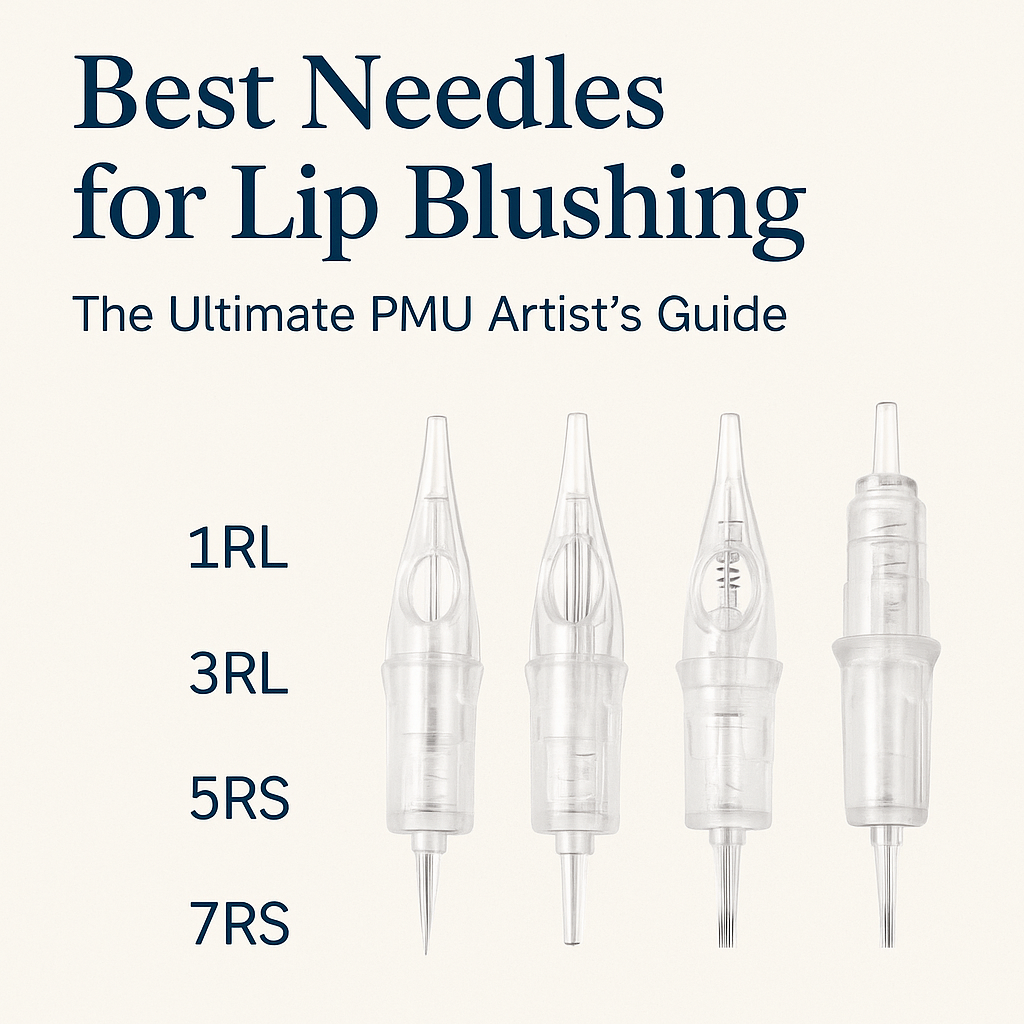
A classic 1RL (one round liner) gives ultra-fine minimal trauma but can be slower and may require more passes on tougher skin.
-
A multi-needle or curved flat row (eg 5U or 8U curved flat) enables more pigment per pass, faster saturation and less trauma due to fewer passes.
-
For nano strokes that mimic hair, you want definition and crispness — so think about how the needle entry and exit behave when pulling or etching the hair stroke.
-
-
Compatibility and hygiene
-
Cartridge systems: Ensure compatibility with your machine. Some are universal cartridges, others are brand/machine-specific.
-
Sterile, sealed single-use is non-negotiable (especially for high-end client-care and for your reputation in the Hills region).
-
Quality matters: good brand, consistent manufacturing, minimal burrs, smooth insertion into pigment and skin.
-
-
Skin type & client considerations
-
On thinner, less oily skin: you may get away with a finer single needle, lighter passes.
-
On oily, textured skin, or clients who’ve had chemo (where skin may respond differently) you may favour a configuration that deposits more pigment per pass to ensure retention and crisp healed hair strokes.
-
As you know, minimizing trauma means better healing, better retention, less swelling/redness etc. The blog by Tina Davies about curved flat cartridges emphasises reduced trauma and faster work.
-
-
Your technique + speed + machine settings
-
Even the best needle won’t compensate for poor angle, wrong depth, insufficient stretch, wrong pigment choice or machine speed too high.
-
Keep the hand stable, skin stretched, angle at ~90° (for many nano strokes) so the stroke is crisp not blurred.
-

Leave a comment
This site is protected by hCaptcha and the hCaptcha Privacy Policy and Terms of Service apply.